

Your Team Is Working. Your Communication Isn’t.
Twenty-five employees. Eight crews. Forty-plus active jobs.
You’ve built something real. And somehow, the bigger it gets, the harder it is to see what’s actually happening.
Not because your crew isn’t working — they are. But because your operation runs on scattered information. Job updates live on individual phones. Photos get texted, then buried. Status exists only in someone’s head until someone asks. Every question requires a call. Every call pulls someone off the job.
Your crews are out there doing the work. But somewhere right now, a job update is stuck on someone’s phone and nobody in the office knows it. Your PM is trying to confirm whether a job site passed inspection. They’ve called the foreman twice. Texted the crew lead. Got a photo back — wrong job. The office admin is on hold with a homeowner asking for an update. They can’t find any proof of a status update. Your estimator is driving out to retake photos that were never sent. A change order got missed because the approval was 200 messages deep in a group chat nobody’s scrolling anymore.
Nobody dropped the ball. The system dropped the ball.
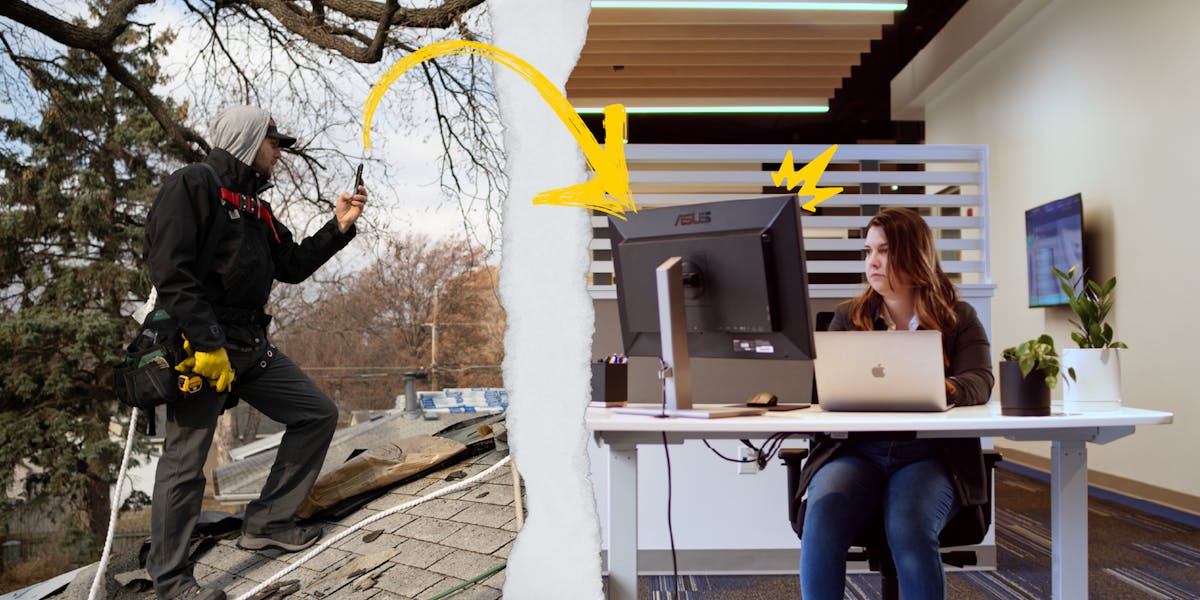
At 10 employees, you could hold it all in your head. At 25, that’s not a system but a liability waiting to happen. And you already know it. You’ve felt it at 7 o’clock when your PM is still chasing documentation. You’ve felt it when a customer calls and nobody has a straight answer. You’ve felt it every time someone says “did you send that photo?”
The chaos isn’t random. It’s what happens when a team grows faster than the way it communicates.
What It Looks Like When Information Has a Home
Same company. Same crews. Same 40 jobs.
But now, every job creates more photos, more messages, more moving pieces, and no clear place for any of it to live.
The difference is that information stops living on individual phones and starts living where the work actually happens: organized by project, visible to everyone who needs it.
When a crew arrives on site, photos go directly into the job. Timestamped. Organized. Visible to the office the moment they’re taken — no follow-up needed. The PM can see it. Sales can pull it up before a customer call without asking anyone. When something changes on site, it’s documented in real time, tied to the project, with a record that’s there when you need it.

Your PM isn’t chasing documentation after hours. They checked the project feed at 4 and already knew where every job stood. The admin answered the homeowner’s question without putting them on hold — they pulled up the project and had everything they needed in 30 seconds. The estimator got what they needed without leaving the office.
Change orders don’t get missed because they’re not living in a text thread. They’re attached to the job, with photos, with timestamps, with a paper trail that holds up.
The work doesn’t change. The way information moves through your business does.
When your whole team, field and office, is looking at the same project in the same place at the same time, the calls stop. The duplicate site visits stop. The 7 PM scrambles stop.
You stop losing hours. And instead of growth creating more chaos, your systems support it. Adding more jobs doesn’t have to mean adding more stress.

You’ve Outgrown the Group Chat
If your team is still running on texts and group chats, the sprawl isn’t going to fix itself. It scales with you. Every new crew, job, and hire adds another thread nobody has time to manage.
The contractors that get ahead of it aren’t the ones with the most employees or the most jobs. They’re the ones that stopped letting information scatter and built a system that keeps everyone aligned — without anyone having to chase it down.

You cannot scale smoothly when every update depends on a call or buried group chat.
Try CompanyCam to document work in real time and keep everyone aligned.