
Nash Everett is an indoor air quality, mold remediation, and mold and air testing company owned by Gary Szymanski. The work takes Gary and his team into crawl spaces, attics, wall cavities, and mechanical systems that most homeowners have never looked at and wouldn’t know how to interpret if they did.
That invisibility creates a specific challenge: clients are paying for work in spaces they can’t see, on problems they can’t fully understand, often while dealing with health concerns that make the whole situation more stressful than a typical home service call.
Trust is the product as much as the remediation itself. And trust, in Gary’s business, comes from documentation. Before CompanyCam, Gary was completing 6+ estimates a day across different properties and relying on memory and Google Photos to keep everything straight. For a business where poor documentation doesn’t just cost money but actively undermines the client relationship, that system wasn’t sustainable.
The Problem: 6 Estimates a Day and No Way to Keep Track
Gary completes more than six estimates every day. Each one involves photographing conditions in spaces that are difficult to access, explaining findings to clients who have never seen those spaces, and creating a record that supports whatever remediation work follows. Keeping all of that organized across six or more properties a day using Google Photos was, in Gary’s words, cumbersome.
The practical problems that created were significant:
- Photos from different estimates on the same day were mixed together with no easy way to separate them
- Gary couldn’t remember specific details from earlier estimates by the time he was writing up findings
- Sharing photos with clients required creating manual Google Photos links that were complicated to set up
- Clients had no way to follow along with work being done in spaces they couldn’t access themselves
- Without organized photo records, communicating with clients about what was found and what was done required far more explanation than the photos alone should have needed
What Changed When Gary Started Using CompanyCam
The shift happened immediately. Gary now pulls up to any property, opens CompanyCam, and creates a project before he gets out of the truck. Whether it’s an estimate or an active work site, every photo he takes from that point is automatically organized under that address.
When he wraps up for the day, six or more complete photo records exist for six or more properties, each one organized, timestamped, and accessible without any manual sorting.
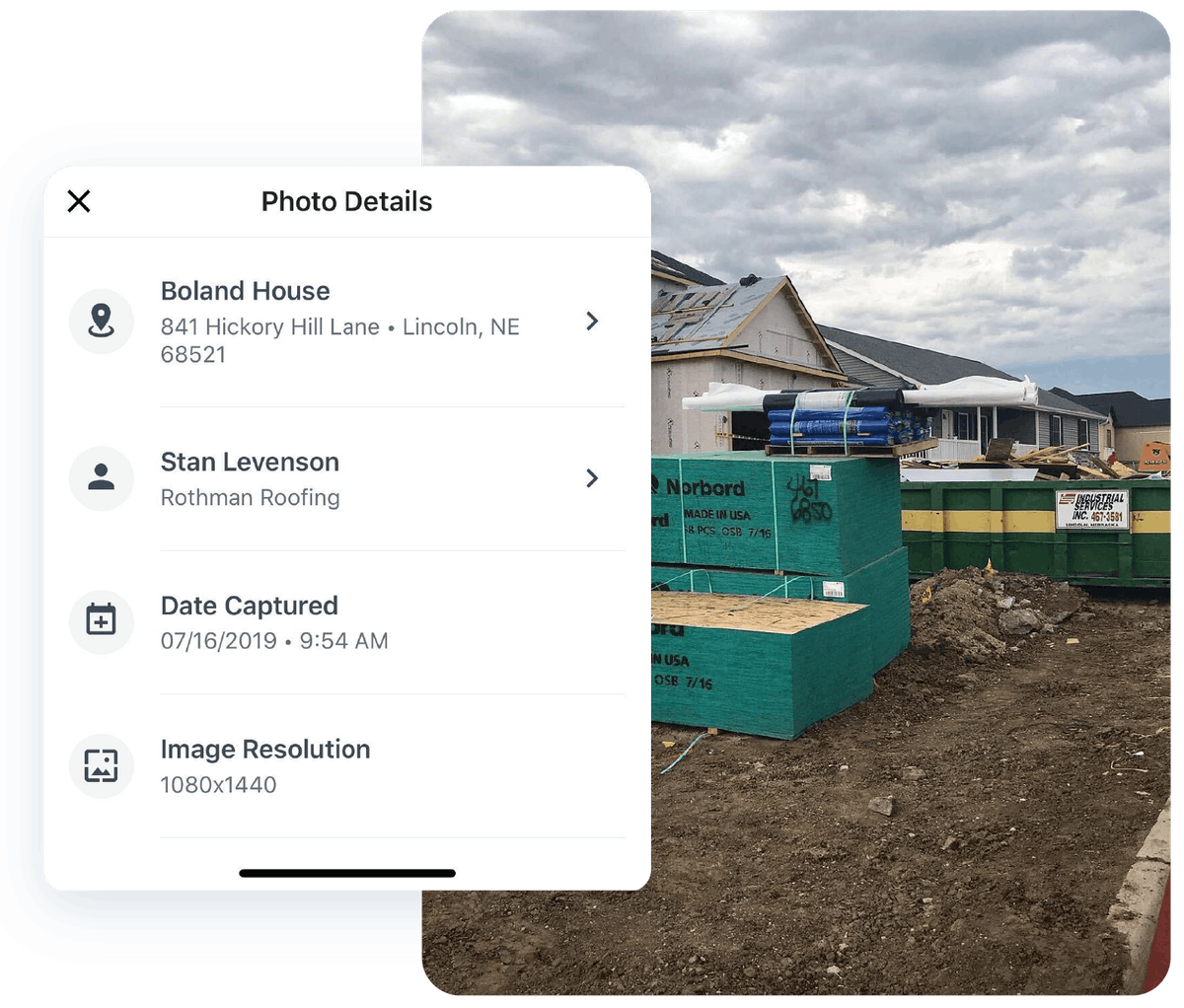
The geotagging feature solved a problem Gary didn’t fully realize he had until it was solved. When he returns to a property he hasn’t visited in two or three weeks, CompanyCam surfaces that project automatically based on his location. “So when I pull up to a house and I haven’t been there in two weeks, three weeks, it’s the first one on my list,” Gary said. “That’s a cool feature. I don’t have to go digging through photos. It’s faster.”
Combined with the basics of project organization in CompanyCam, Gary went from a documentation process that required constant manual effort to one that largely runs itself.
300 Photos Per Project and the Clients Who Love It
Nash Everett projects regularly accumulate 300 photos. In an industry where clients are paying for work they can’t see in spaces they’ve never been, that volume of documentation isn’t excessive. It’s the point. Every photo is evidence that work was done, conditions were found, and the remediation Gary proposed was actually necessary.
The shareable timeline link is the feature Gary uses to put that evidence in front of his clients. Instead of calling to update a homeowner on what his crew found behind a wall, Gary sends them a link. They open it on their phone and see every photo in real time, organized chronologically, with notes explaining what they’re looking at. “I just tell the customer, ‘here is your CompanyCam link to your home project,’ and that alleviates a lot of back and forth,” Gary said.
Sharing photos through timelines and galleries changed Gary’s client conversations from explanations of invisible problems to visual walkthroughs that clients can follow without any technical knowledge.
How CompanyCam Eliminated Unnecessary Site Visits
Gary runs a small operation. Every hour he spends driving to a site to oversee something his crew is already handling is an hour he can’t spend on estimates, client calls, or the next job. Before CompanyCam, staying on top of active projects meant being present for them, or at least checking in by phone. Neither approach scaled when he was running 6+ estimates a day.
With CompanyCam, Gary can see what’s happening on any active project from wherever he is. His project managers upload photos as they work. Gary reviews them in real time and gives feedback without anyone having to stop what they’re doing for a status call.
“CompanyCam gives me the opportunity to have my eyes on the job at all times,” he said. The site visits that used to take up time he didn’t have now happen only when something actually requires his physical presence. For a small business owner trying to keep track of every job site without calling field crews, that shift opened up real capacity.

How CompanyCam Helps Close More Business
The documentation Gary produces isn’t just for existing clients. It’s also a business development tool. The shareable timeline link, which Gary initially adopted for client communication, turned out to be one of the most effective things he could show a prospective customer.
When a potential client is trying to decide whether to hire Nash Everett, Gary can pull up a timeline from a comparable past project and walk them through exactly what that job looked like, what was found, and what was done. Seeing a complete, professional photo record from a real job is more persuasive than any proposal or brochure.
Gary credits the timeline feature directly with helping him close more business, which makes it one of the few documentation tools that pays off on both sides of the client relationship. The same approach works for marketing the business more broadly, turning job site photos into content that builds credibility before a prospect ever picks up the phone.
The Case for CompanyCam
Gary Szymanski runs a business where clients pay for work in spaces they will never see. His entire value proposition rests on the quality of his documentation and his ability to communicate what was found and what was done in a way that builds confidence rather than doubt. CompanyCam gave him the system to do that consistently across six or more estimates and multiple active projects every single day.
“CompanyCam saves me time. And it saves me trips all the time now,” Gary said. “I don’t have to go to the site and oversee everything anymore.” For an indoor air quality company built on trust in invisible spaces, the tool that made the biggest difference was the one that made everything visible.